

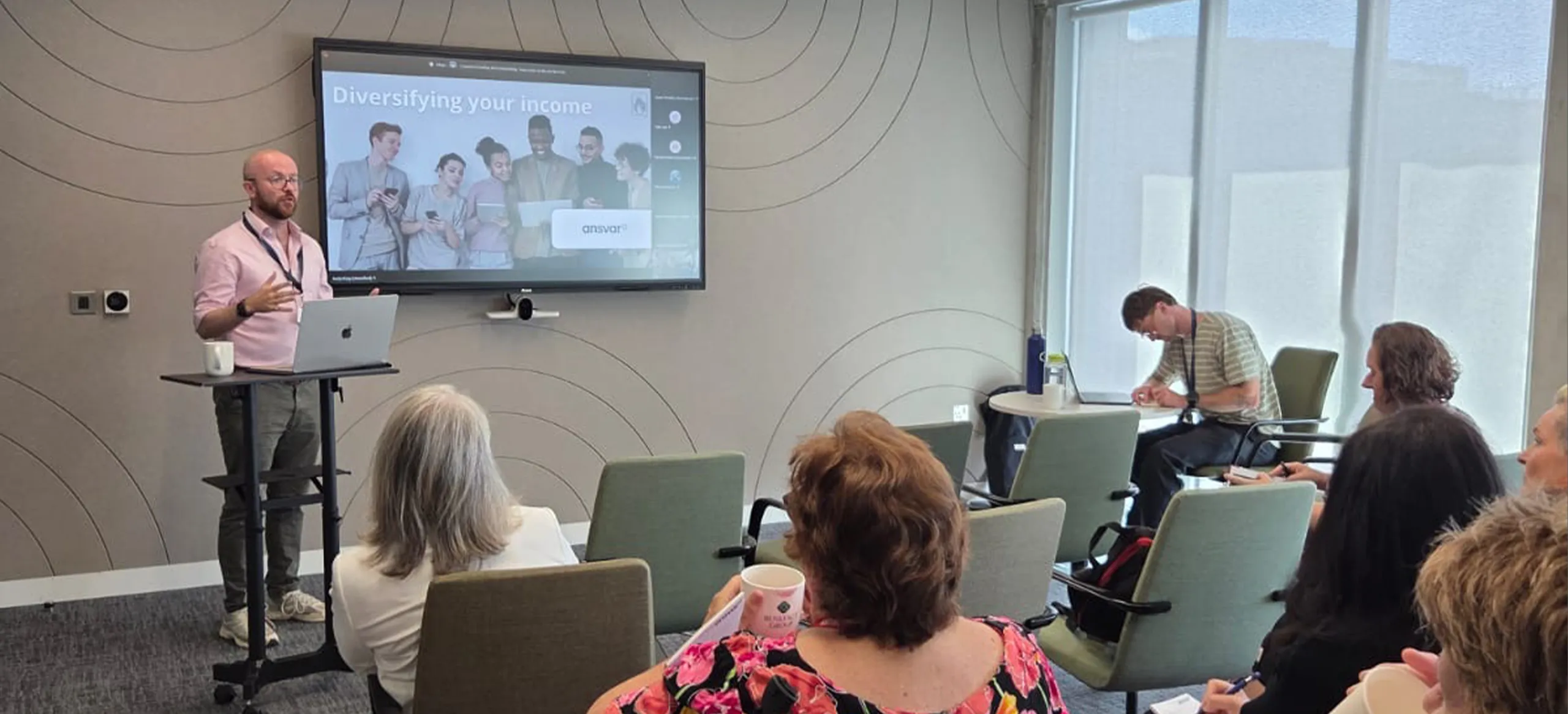
Hosted by Ansvar, the session challenged charities to rethink where they look for support and how they communicate their impact.
At Ansvar’s July Community Hub Event, Andy King, Director of Fireside Fundraising, shared practical advice on how charities can diversify their income and build stronger fundraising strategies.
A key message throughout the session was that charities should stop asking “Where is the money?” and instead ask “Who cares about the problem we solve?” Andy argued that it is far easier to engage people who are already interested in a cause than to persuade wealthy people to care about it.
The session also explored the reality of fundraising in an increasingly crowded landscape. With inboxes full, attention spans stretched and competition for funding growing, charities need to communicate clearly and simply. Successful organisations stand out by focusing on the emotional impact of their work, rather than the complexity of their services.
One of the most thought-provoking discussions centred on the idea that donors give to solve problems, not fund solutions. Charities often talk about programmes, projects and services, but supporters are more likely to respond to a clear explanation of the problem being addressed and why it matters.
Andy introduced a practical exercise called Community Mapping, designed to help organisations identify new fundraising opportunities. Participants were encouraged to consider who benefits directly from their work, who is connected to those beneficiaries, who gains when the charity succeeds and who may be missing from their network. This approach helps uncover potential supporters, partners, businesses and major donors who are already aligned with the charity’s mission.
The session also outlined a typical fundraising growth journey, with many charities beginning with trusts and statutory funding before expanding into corporate partnerships, major donors, individual giving and, eventually, legacy fundraising. The emphasis throughout was on building relationships and making the most of existing networks.
Finally, Andy touched on the growing use of AI in fundraising. While AI can be a useful tool for research and administration, he stressed that it should support, not replace, human judgement and authentic relationship-building.
The event concluded with three simple takeaways: be persistent, lead with emotion and focus on people who already care about the problem you are trying to solve. By understanding their communities and building meaningful connections, charities can create more sustainable and diverse income streams for the future.
